Why most marketing spend is wasted and what to do about it

Jon Richardson • February 15, 2026

Stop Paying for Marketing That Doesn't Work: A Simple Guide to Getting More Enquiries


We have all been there, £2000 spent and no calls! You hand over thousands of pounds to someone who promises to "get your website to the top of Google." A few months pass. Maybe you get a fancy report every month. But when you check your phone? Silence. No calls. No enquiries. No new customers walking through the door.


It's the single most frustrating problem facing small business owners. You're working flat out, doing a brilliant job for your customers, but the marketing side feels like throwing money into a black hole.


The truth is, most marketing doesn't fail because it's poorly done. It fails because it's not focused on the right goal, i.e. making your phone ring.


Why Your Marketing Budget Disappears Without Results


Let's be honest about what usually happens when small businesses try to market themselves.

Someone sells you on Facebook ads. You spend £50 a day for a month. You get hundreds of clicks, maybe thousands of "impressions" (whatever those are). The report looks impressive. But you can count the actual enquiries on one hand, and half of them are time-wasters.


Or maybe you paid for a fancy website redesign. It looks gorgeous. Your mate said it's "really professional." But six months later, you're still getting the same trickle of enquiries you had before.


The issue isn't that these things never work. The real problem is they're often sold as if they're the whole answer, when they're just part of the bigger picture. You don't just need more website visitors; you need more people calling you or filling out your contact form.

Most marketing agencies make their money from monthly retainers and big upfront fees. They're incentivised to keep you paying, not necessarily to get you results. That's not a conspiracy theory: it's just the way the industry works.


What Actually Brings In Enquiries (Without Breaking the Bank)


Now, let's look at what actually works for real businesses serving real customers.


Make It Stupidly Easy to Find You


When someone searches "plumber near me" or "accountant in Bournemouth," you want to show up. Not necessarily with a paid ad: with a proper listing that shows you're local, legitimate, and available.


Your Google Business Profile is free. Completely free. Yet most small businesses either don't claim it or leave it half-finished. Make sure yours has:


  • Your actual phone number (not just a contact form)
  • Current opening hours
  • Recent photos of your work or premises
  • Responses to any reviews, good or bad


This one step brings in more quality enquiries than most paid ads, because people searching are already interested in your services. You're not interrupting them; you're providing the answer they need.


Ask Your Happy Customers to Spread the Word


Here's a surprising fact: 18% of businesses earn £70 for every £1 they spend on keeping in touch with their existing customers. It's not about finding new customers, but about staying in touch with those who already trust you.


Most small business owners struggle with this. You do great work, the customer is happy, they pay you, and then that's it. You don't talk again until they need you much later.


Try this instead:


  • Two weeks after finishing a job, send a message asking how everything's going.
  • If they're happy, ask if they know anyone else who might need your services.
  • Keep a simple list of past customers and drop them a note every few months.


You don't need costly software or complex systems. A simple spreadsheet and your phone are enough. The businesses with the most referrals aren't always those with the biggest marketing budgets; they're the ones who just ask. 


They ask you all the time. The ones you answer on the phone, in the shop, or at the start of every new job.  Write them down. Then put those answers on your website as frequently asked questions or on social media (or better still, on both).


"How much does X typically cost?"

"What should I look for when choosing a Y?"

"How long does Z usually take?"


When someone searches those questions and finds your answer, they're already halfway to becoming your customer. You've shown how good you are without spending anything on advertising.


This method works especially well for service businesses, since people prefer to work with local experts they trust. A real, helpful answer is always better than a flashy advert.


However, if you are unsure about whether you should have a CRM (customer relationship management) system, you can find out more about them by clicking the link below:


>>>CRM Systems<<<


Use Social Media Like a Human, Not a Billboard
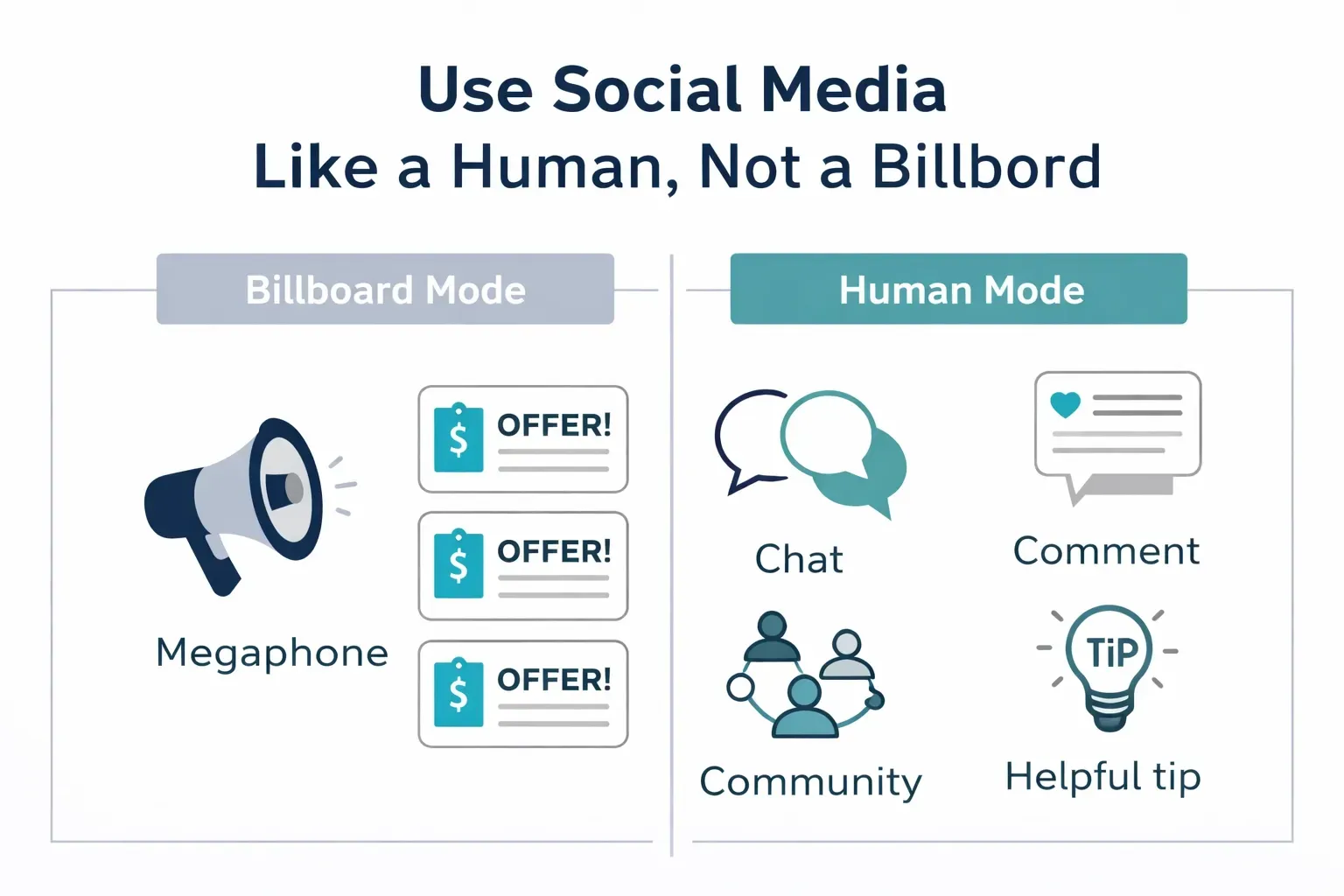


You know what doesn't work on social media? Posting "SPECIAL OFFER THIS WEEK ONLY" three times a day.

What does work is engaging with your local community. Comment on posts from other businesses, share helpful information, and let people see the human side of your business.


Research shows that 66% of businesses generate leads by spending just 6 hours a week on social media. They aren't posting all the time or running costly ad campaigns. They're simply present, helpful, and genuine.


Join the local community groups. Answer questions when people ask for recommendations. Build relationships first, business second.


The Low-Cost Approach That Actually Gets Results


The truth is, you don't need a huge marketing budget to get more enquiries. You just need to do a few simple things well and stick with them.


Start with the free stuff:

  • Claim and optimise your Google Business Profile
  • Ask satisfied customers for reviews and referrals.
  • Post helpful content that answers real questions.
  • Engage genuinely on social media.


Then test one paid approach:

  • A small budget for Google Ads targeting local searches
  • A modest spend on Facebook ads to a very specific local audience
  • Sponsored posts to the right community groups


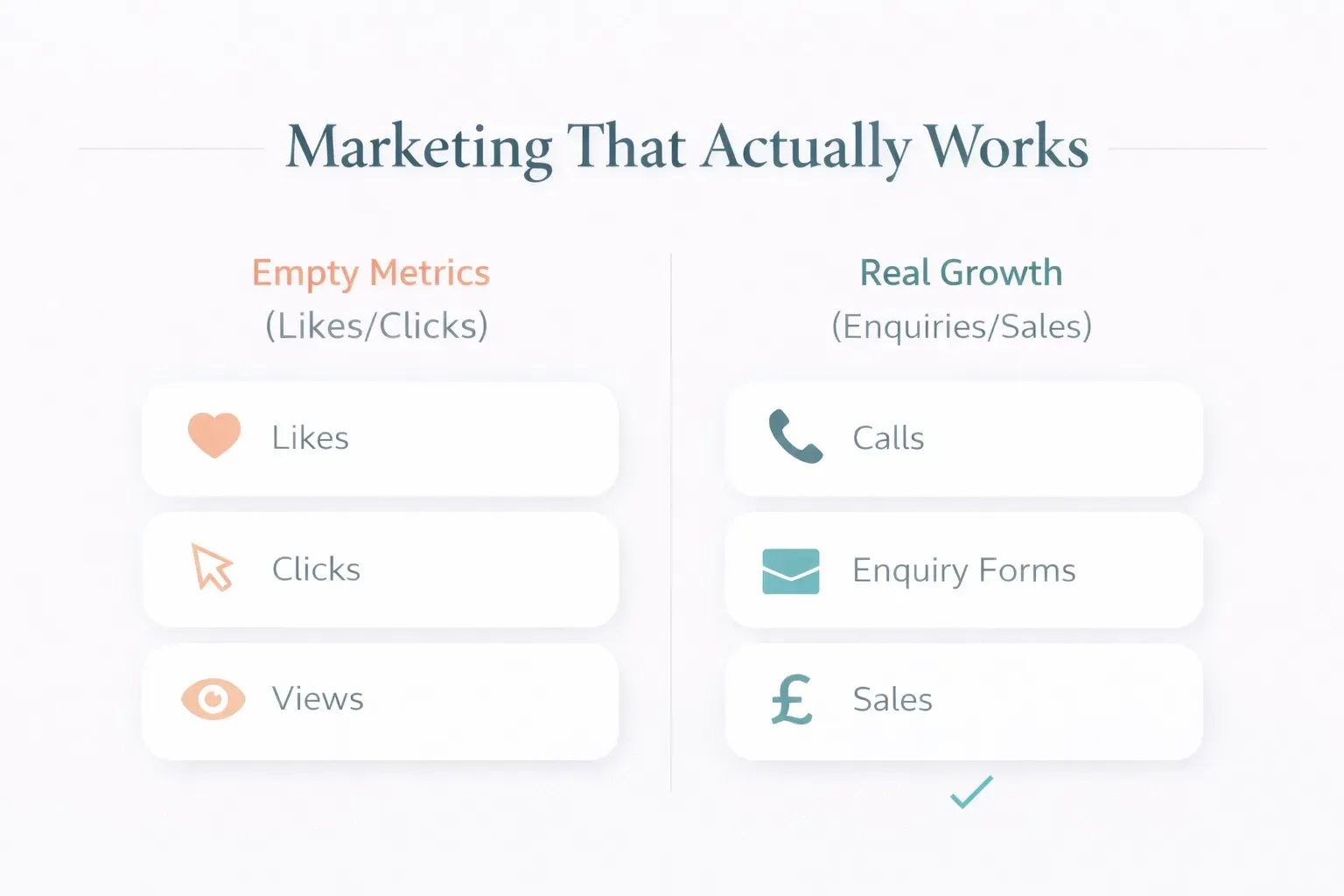
The main idea is to test. Don't sign up for large monthly fees. Try something small, see how many real enquiries you get, not merely clicks or impressions—and then decide if it's worth continuing. Many digital marketing services require you to commit for 6 or 12 months upfront. That benefits them, but not you if it doesn't work. Choose options that let you start small and grow only when you see real results.


Your Simple Action Plan for This Week


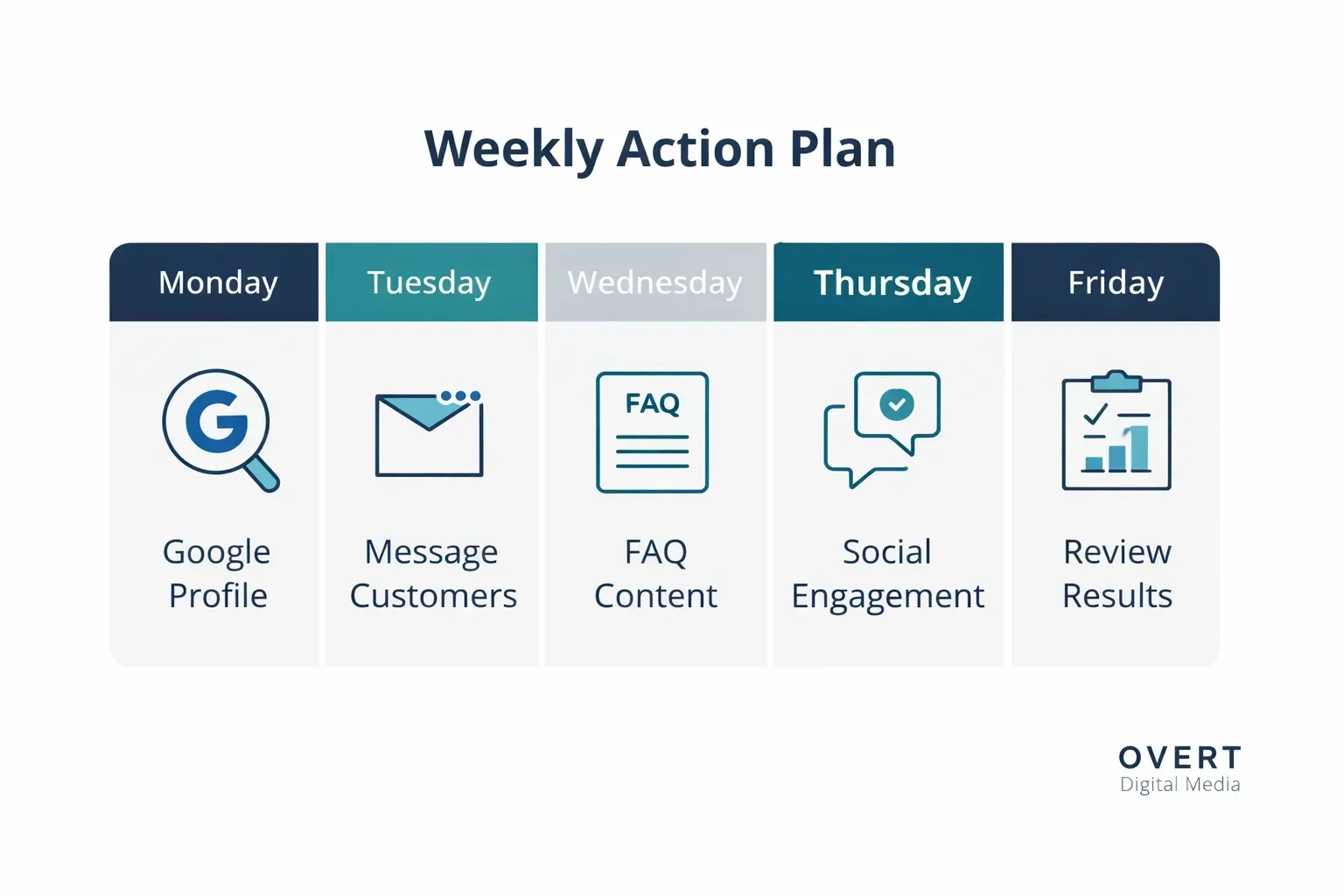
Stop for a moment. You don't need to do everything at once. Here's what to do this week:


  • Monday: Claim or update your Google Business Profile. Add five recent photos and your correct phone number.
  • Tuesday: Make a list of your ten happiest customers from the past year. Message three of them asking how things are going.
  • Wednesday: Write down the three questions customers ask most often. Turn one into a simple post or webpage.
  • Thursday: Spend 30 minutes engaging with the local community groups or business pages on social media. Be helpful, not salesy.
  • Friday: Review the enquiries you've received this week. Where did they come from? Do more of that. That's all you need. No complex strategies or costly tools. Just steady, practical steps aimed at what matters most, getting more real enquiries from people who want your services.er.

The Bottom Line


It's not that you're spending too little on marketing; it's likely that you're spending it in the wrong areas. The businesses with steady enquiries aren't always those with the biggest budgets. They're the ones who are easy to find, keep in touch with happy customers, and show up where their customers are looking.


If your current marketing isn't bringing in enquiries, stop. Don't keep spending more on it. Begin with the basics that only require consistency, and only add more when you can see a direct link between spending and real customer enquiries.


Your phone should ring more. Your website contact form should be getting completed. That's what marketing success looks like for a real business: not fancy reports or impressive-sounding metrics.


Want help figuring out what's actually working for your business? We work with businesses across Dorset and Hampshire on practical approaches that focus on results, not retainers. No huge upfront fees. No locking you into long contracts. Just straightforward marketing that brings in the enquiries your business deserves.



By Jon Richardson July 4, 2026
If your website were your sole source of leads, would you have a business today?
By Jon Richardson June 29, 2026
How to get found in AI Things are different now. For a long time, small business owners were told to aim for page one on Google. You worked on keywords, updated your meta tags, and hoped it would pay off. But now, the way people find your business is changing quickly. Google’s search results are starting to be replaced by AI Overviews . Instead of scrolling through links, people now ask ChatGPT, Gemini, and Perplexity for recommendations. These tools are not just search engines; they are answer engines. If your website isn’t set up for Large Language Models (LLMs), your business may not show up for the AI assistants your customers use. Here’s what you should know to stay visible in today’s digital marketing world. Stop Thinking Keywords, Start Thinking Context Traditional SEO focused on matching words. If someone searched for "plumber in Christchurch," you made sure that phrase was on your page. LLM optimisation, sometimes called Generative Engine Optimization (GEO), is different. AI models look for understanding, not just keywords . AI reads your site to learn who you are, what you offer, and how trustworthy you seem. When someone asks ChatGPT, "Who is the best web designer for a small law firm in Bournemouth?", the AI checks its training data and the web for the best answer. If your site only has keywords and lacks clear context, the AI will ignore it. The AI Playbook: 3 Ways to Get Recommended To show up in AI-generated answers, your website should be a main source of reliable information. Here’s how you can do that: 1. Use the "Inverted Pyramid" for Answers AI models work quickly and want answers right away. Set up your service pages like a news article: The Direct Answer: Start with a 50-60 word summary that explicitly states what you do and who it's for. The Context: Next, explain how you work, why you do it that way, your process, what makes you different, and your local knowledge. The Proof: Finish with facts, customer testimonials, and real case studies. If you run a cleaning company in Southampton, don’t hide your list of services at the end. Let the AI and your visitors know what you offer right at the start. 2. Turn Headings into Questions People talk to AI. They ask things like, "How much does a new website cost in Dorset?" or "What's included in a social media management package?" Instead of a plain heading like "Our Prices," try a question such as "How much do our web design services in Christchurch cost?" This makes it much easier for an LLM to match your content to what users ask. 3. Make the Most of Structured Data (Schema) Schema Markup is a special language for machines. It’s code that tells AI your business name, your address in the New Forest, your opening hours, and your service categories. At Overt Digital Media, we make sure every site we build uses advanced SEO and schema tagging. This way, when an AI bot visits your site, it doesn’t have to guess your details. It knows them for sure. Why Local Authority Still Wins AI models care about how close you are and your reputation. They look for real businesses with a strong presence. That’s why it’s more important than ever to be consistent across the web. If your address is different on social media and your website, it can confuse the AI. Whether you run a micro-pub in Bournemouth or work as an IT specialist in Southampton, keeping your Name, Address, and Phone (NAP) consistent across Dorset and Hampshire signals to AI that your business is real and trustworthy. Is Your Website Ready for the AI Shift? The shift from traditional search to AI-driven answers isn’t coming; it’s happening right now. The businesses that adapt today will be the ones ChatGPT and Gemini recommend as top choices tomorrow. Don’t let your business disappear online. Make sure your website is speaking clearly to these new AI models. Is your website AI-ready? Get a free website audit today and we'll show you exactly where you stand and how to start ranking for the future.
By Jon Richardson June 24, 2026
This is a subtitle for your new post
By Jon Richardson June 8, 2026
This is a subtitle for your new post
By Jon Richardson May 18, 2026
How to Choose the Right AI Agency for your business The AI gold rush is in full swing. Spend five minutes on LinkedIn or at any networking event, and you’ll see plenty of AI consultants. That’s the problem. Every agency is suddenly an "AI agency." Every consultant is an "AI expert." Strip away the buzzwords, and most business owners are left asking a very fair question: What am I actually paying for here? If you're thinking about bringing AI into your business, and you should be, you’re probably not looking for something flashy. You want less admin. Fewer repetitive jobs and more time for the work that actually matters. That’s really what this comes down to. The right partner helps you get time back. The wrong one gives you an expensive toy you won’t use. So if you're trying to work out who actually knows their stuff and who’s just rebranded last week, here’s how to tell. 1. Don’t be blinded by the technology The biggest mistake you can make is hiring someone who talks about technology before they understand your business. You’ve probably heard the pitch before. We can install this clever tool. We can build that smart assistant. Fine. But if they haven’t asked how your enquiries come in, where jobs get stuck, or what your team keeps doing manually every single day, they’re guessing. A good partner starts with questions like: "What happens with inbound leads?" "Where do things slow down?" "What are you doing several times per day?" "What takes up time and headspace for no good reason?" That’s the real starting point. Not the software. Not the demo. Not the dramatic promises. If they can’t clearly explain why something will make your day easier, save your team time, or remove a bottleneck, it’s probably not the right fit. If getting a few hours back each week sounds useful, get in touch, and we’ll help you spot the obvious time drains. 
By Jon Richardson April 11, 2026
Let’s be honest: you’re probably tough to contact That’s not a criticism. It just means you’re successful. Whether you’re a solicitor in Christchurch, a high-end salon owner in Bournemouth, or a trade specialist in the New Forest, you’re busy, in meetings, on-site, and focused on the work that keeps your business running. Here’s the issue: while you’re focused on your work, you’re missing new opportunities. When a contact form goes unread for hours, or a call goes to voicemail, you’ve effectively lost that lead you have worked so hard for. In today’s world, the fastest responder wins—not just the one who offers the best service. If you slow your sales process, you could lose leads before you even speak with them. The Brutal Reality of "Speed to Lead" People expect quick answers. If someone in Bournemouth needs a service at 7:35 PM on a Saturday, they want their problem solved right away or at least to know that someone will help as soon as possible. Your chances of converting a lead drop by 80% if you wait more than ten minutes to respond. By the time you finish a coffee or a client call, your lead may already have contacted someone else. If you’re not the first to answer or reply, you risk losing out. Today’s customers see slow responses as unreliable. If you take two days to respond to a quote request, they might think the whole job will take much longer. The Manual Bottleneck: Why You Are the Problem Most business owners we meet at Overt Digital Media value their personal touch. They like to answer emails themselves and to be the voice on the phone. But this approach may slow your growth. Think about your current process: A potential customer fills out a form on your website. An email notification lands in your inbox (among 50 other emails). You see it 45 minutes later while grabbing lunch. You tell yourself, "I'll reply when I get back to the office." You get back to the office, get distracted by an urgent issue, and finally reply at 6:00 PM. By 6:00 PM, that lead has already booked a consultation with another s eo agency in Christchurch or a different local provider who has a system in place to catch them instantly. Manually following up is tiring and inconsistent. It often makes you switch tasks, breaking your focus and lowering productivity. You end up doing admin work for free and missing out on income. Enter the 24/7 Gatekeeper: The AI Receptionist The most common problem is missing phone calls. You might be on another call, driving, or simply taking a break from work. Voicemail rarely works for leads. Fewer than one in ten people leave messages; most just hang up and call someone else. This is where an AI Receptionist comes in. Unlike a traditional answering service, which just takes a name and number. An AI receptionist can actually handle the inquiry. It can answer questions, qualify leads, and even book an appointment directly in your calendar. Picture a client calling your business at midnight. Instead of no going through to voicemail, they reach an intelligent assistant who answers their questions and books a meeting for Monday morning. You wake up to a full calendar, and your client feels confident. This is how you stay ahead without answering every call yourself. Book a demonstration of our AI Receptionist
By Jon Richardson March 23, 2026
Is your business closed after 5? - The cost of operating 9-5 in a 24/7 world
By Jon Richardson March 1, 2026
Beyond the Hype: Why Marblism and Relay.app are Redefining Productivity
By Jon Richardson February 1, 2026
Google Business Profile - Your Free & Secret SEO Tool
By Jon Richardson January 13, 2026
Why updating your Google Business Profile is a genuine no-brainer for local businesses.