Your Google Business Profile is more important than you think - here's why
Google Business Profile - Your Free & Secret SEO Tool
Many businesses still make the mistake of treating their Google Business Profile like a digital business card—setting it up once and then ignoring it. But today, your Google Business Profile is the single most important driver of your online visibility.
It’s now the core of modern SEO; ignoring its potential means falling behind.
Your Google Business Profile is now at the heart of your SEO strategy. It’s not just about appearing on Google Maps for 'near me' searches. It shapes how Google understands, ranks, and displays your business everywhere—from search results to discovery feeds to voice search.
Key takeaway: Google Business Profile is no longer just a 'local SEO' tool. Elevate your SEO strategy by optimising it fully.
The Shift Nobody's Talking About
Traditional SEO was simple: you optimised your website, built backlinks, created content, and waited for Google to rank you. Your website was the main focus.
Not anymore.
Google has changed how it shows business information. Now, when someone searches for your services, Google shows more than just ten blue links. You’ll see a Knowledge Panel, review snippets, Q&A, business hours, photos, and posts. Most of this information comes from your Google Business Profile before your website.
The reality is that businesses with optimized Google Business Profiles are 70% more likely to get visits from potential customers. Even more important, those visitors are 50% more likely to become actual customers compared to regular organic traffic.
This happens because Google Business Profiles build a unique kind of trust. When people see real reviews, recent posts, fast answers to questions, and current information in one place, they often decide to buy before even visiting your website.
Key takeaway: Your website remains important, but your Google Business Profile is now equally critical to attracting and converting customers.
How GBP Actually Changes Your SEO Strategy
1. You're Now Optimising for Multiple Platforms Simultaneously
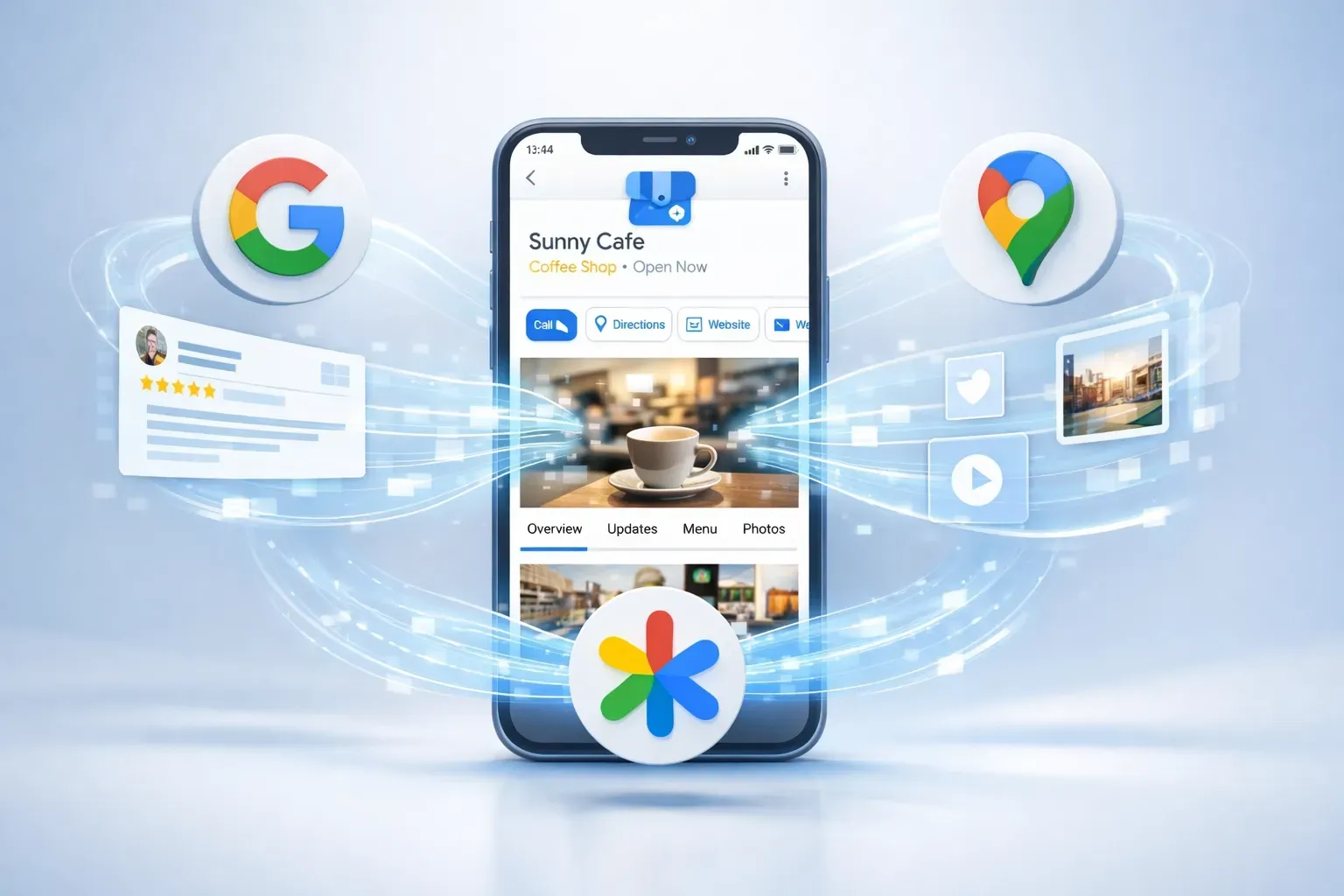
Every detail you add to your Google Business Profile affects more than one platform. It spreads across Google Search, Google Maps, and the Local Pack—the top three businesses shown in local search results.
Think about what that means for resource allocation. You're no longer choosing between optimising for search and maps. You're doing both at once. That's not efficiency: that's a fundamental shift in how SEO works.
For instance, when we work with businesses: whether they're based in Christchurch, London, or Manchester, the first thing we audit is their GBP completeness score. Most businesses sit at around 60% complete. Getting to 100% doesn't just improve one ranking factor. It improves visibility across every Google property that matters.
2. Reviews Have Become Algorithmic, Not Just Social Proof
Customer reviews used to be nice to have. Now they're a direct ranking signal.
Businesses that respond to at least 25% of their reviews see an average revenue increase of 35%. But it's not just about the money. Google's algorithm actively prioritises businesses that demonstrate customer engagement. Every review you get, every response you write, every photo a customer uploads: it all feeds into how Google ranks you.
This means you need a review management system, not just hoping happy customers leave feedback. You need to make it easy. You need to respond fast. You need to treat review management as seriously as you treat content creation.
Want a review of your Google Business Profile?
Just complete the form below, and a member of the team will send you a full report on how your Google Business Profile is performing
Contact Us
3. Fresh Content Doesn't Always Mean Blog Posts Anymore
Google Business Posts are the most underutilised SEO tool in 2026. These are the updates you can publish directly to your profile: offers, events, product announcements, and general updates.
Most businesses ignore them. Smart businesses use them strategically.
Here's why they matter: Google Posts appear directly in search results and in your Knowledge Panel. They give you a way to control the narrative about your business in real-time. They signal to Google that your business is active, engaged, and worth showing to searchers.
We've seen businesses double their profile engagement by posting just once a week. That's not a time-intensive strategy. That's 15 minutes a week for measurable results.
4. Local SEO Isn't Just for Local Businesses
This misconception needs to die.
You might be thinking: "We serve clients nationally", or "We're an e-commerce business", or "We don't rely on local foot traffic."
This is irrelevant
Google doesn't think in terms of local vs. national anymore. It thinks in terms of relevance and trust signals. Your Google Business Profile provides both. Even if you're a consultancy serving clients across the UK, having a fully optimised profile with your office location, reviews from clients, and regular updates makes you more credible in Google's eyes.
It's not about geography. It's about authority.
5. The Free Alternative to Paid Advertising
Here's something that should get every marketing director's attention: Google Business Profiles eliminate the barrier to first-page visibility.
Traditionally, getting to page one meant months of SEO work or expensive Google Ads campaigns. With GBP, you can appear in the Local Pack: prime real estate at the top of search results, without spending a penny on ads.
This changes budget allocation entirely. Often, the ROI from optimising your profile exceeds what you gain from paid search campaigns. While this isn't true in every case, it's frequent enough that you should regularly evaluate your spending priorities.
What This Means for Your Actual SEO Work
Stop thinking of your Google Business Profile as a separate tactic. It needs to be integrated into everything you do.
- When creating website content, consider how you can repurpose key points into Google Posts.
- When you get customer testimonials, convert them into review requests with direct links to your profile.
- When you update your services, make sure your GBP categories and service descriptions match exactly what's on your website.
- When you post new photos of your work on social media, take a few seconds to also upload them to your profile, not just your portfolio page.
This isn't double work. It's strategic amplification.
The Implementation Checklist
Here's what you need to do right now:
Audit your profile completeness. Google provides a score. Get it to 100%. Fill in every field, every category, every service option.
Set up review automation. Create a system that asks for reviews at the right moment in your customer journey. Make it frictionless.
Create a posting schedule. Weekly at a minimum. Share updates, insights, offers, case studies: anything that demonstrates activity.
Monitor and respond to Q&A. The Questions & Answers section on your profile is public. If you're not answering questions, your competitors might be. Or worse, random users.
Add booking and action buttons. Make it dead simple for people to take the next step without having to click through to your website.
Upload high-quality photos monthly. Businesses with photos receive 42% more requests for directions and 35% more website clicks.
If you're running a web design or SEO campaign, your GBP should be the first thing you optimise, not an afterthought.
The Bottom Line
Your Google Business Profile isn't a listing. It's a platform.
It's where Google gets its primary information about your business. It's where potential customers make their first judgment. It's where reviews, photos, posts, and responses combine to create a complete picture of who you are and what you offer.
The businesses winning at SEO in 2026 understand that optimisation happens in multiple places simultaneously. Your website matters. Your content matters. But your Google Business Profile is the connective tissue that makes everything else work harder.
Bottom line: Treat your Google Business Profile as the central hub of your digital strategy, not as a secondary task.
That is the current reality.
Request a free marketing review
Contact Us