How to rank at the top of Google for 'Near Me' searches

Jon Richardson • June 26, 2024

Securing a steady stream of local customers with Near Me and Location Based Searches

Introduction


For local businesses, ranking well in "near me" searches presents a significant opportunity to grow their business. Usually, businesses open in areas that have a steady stream of customers nearby. The problem is, however, that so do their competitors, all of whom are targeting the same customers.


So, how do you ensure that you are the first option a potential customer considers when looking for your products or services, rather than one of your competitors?


The answer to this question requires you to understand where these potential customers are looking. More often than not, this is on Google.

For location-focused searches, like 'best restaurant in Christchurch' or 'electrician near me,' Google will serve up the Map Pack at the top of the search results, just under the sponsored listings (adverts).


So it is vitally important if you want to rank highly for 'near me' searches that your business ranks highly on Google Maps.

In this blog, we will look at how you can do that.


How To Rank For Near Me Searches


Consumers leverage their devices to find nearby restaurants, stores, and services with a quick "near me" search. This trend presents a golden opportunity for local businesses to capture valuable local traffic. So, how can you ensure your company ranks high in these crucial searches? Let's look more into "near me" SEO and unlock its potential for your business.

Understanding "Near Me" Searches


Consumers, particularly those on the go, leverage the power of their smartphones to find what they need instantly. Enter the ubiquitous "near me" search – a game-changer for local businesses and a powerful tool for time-pressed consumers.  Imagine you're hungry after a long day and crave something to eat. Or you're on a trip and urgently need to find a pharmacy. In both instances, your trusty smartphone becomes your lifeline. A quick "pizza near me" or "pharmacy in Christchurch" typed into the search bar unleashes a wave of relevant local options, all conveniently displayed within minutes. This, in essence, is the power of the "near me" search.


But how do search engines like Google determine which businesses appear at the top of these crucial searches? Location plays a starring role. Sophisticated algorithms leverage a user's current location to prioritise the geographically closest results. This ensures users are presented with the most relevant and convenient options—a pizzeria down the street or a pharmacy within a few blocks.


The rise of mobile searches has undeniably fuelled the popularity of "near me" queries. Location services on smartphones seamlessly integrate with search engines, making it effortless for users to find what they need nearby. Furthermore, advanced algorithms have become adept at understanding the intent behind these searches. When someone types "pizza near me," it's not just about finding a pizzeria; it's about finding one that's open now, has good reviews, and offers the type of pizza they're craving.

By understanding the power of "near me" or location-focused searches and implementing effective optimisation strategies to rank highly for them, you can unlock significant growth potential and stay ahead of the curve in today's competitive landscape.


Different types of near-me searches


"Near me" searches are a goldmine for local businesses, but they encompass more than just tacking "near me" onto the end of a generic term. Understanding the variations of "near me" searches will help you tailor your approach and attract a wider range of local customers. Here's a breakdown of some key variations to consider:


Location-Specific Searches: These are the classic "business type near me" searches, like "pizza in Christchurch" or "pharmacy in Ringwood." They target users with a clear need and immediate intent.


Time-Sensitive Searches: Searches including phrases like "open now near me" or "late-night cafes near me" show a strong urgency. Optimising your hours of operation and highlighting features like late-night service can be crucial here.


Unique Selling Proposition (USP) Searches: Users might search for "best [business type] near me" or "[USP] + near me." for example "Best seafood restaurant near me" This shows they're looking for options that stand out, so highlight what makes your business unique in your local listings.


Open Now Searches These types of searches are often used for convenience, so ensuring that your opening hours are listed on your Google Business Profile and website will help you rank at the times of day you are open.


By understanding these variations and incorporating them into your local SEO strategy, you can significantly increase your visibility in "near me" searches and attract more local customers who are ready to visit your business.


Some Statistics about 'Near me' or location based searches


  • 1.5 billion "near me" searches per month.
  • 84% of "near me" searches are on mobile.
  • 82% of smartphone shoppers use "near me" searches.
  • 200%+ growth in mobile searches for “Open” + “now” + “near me”.
  • 78% of location-based mobile searches result in an offline purchase.
  • 46% of all Google searches are for local businesses, and 93% of searches for local businesses on Google include the Local 3-Pack.
  • The 3-Pack results get 44% of actual clicks on a results page.
  • 68% of people who search online prefer to click on the local 3-pack, 27% prefer organic results, and 10% trust paid search results.


44% of people making local or 'near me' searches click on the Map Pack
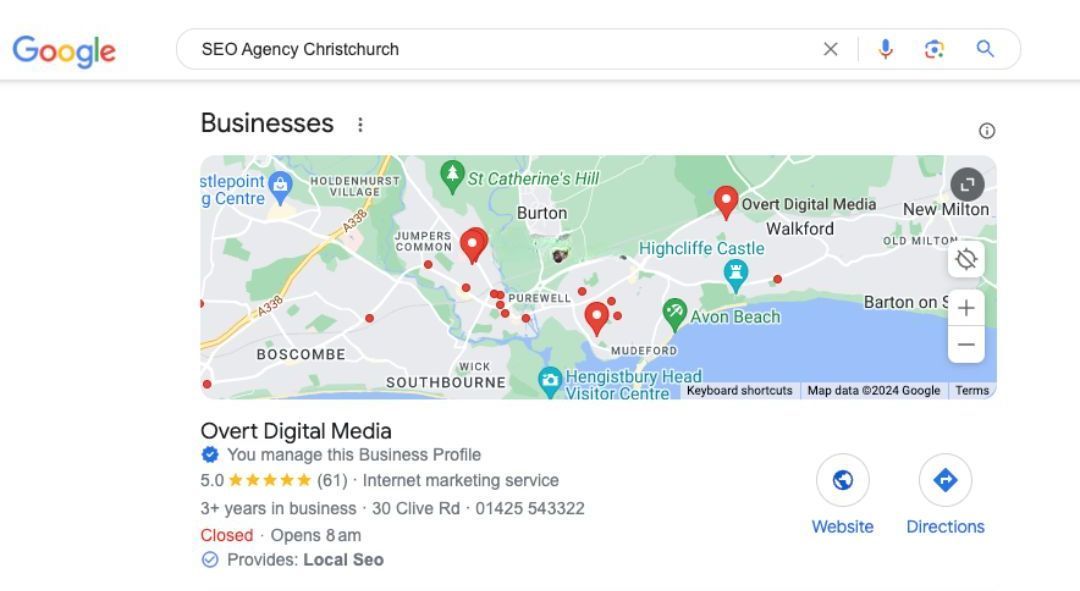
The Map Pack showing Overt Digital Media ranking top for SEO Agency Christchurch

Read Enough and want to know how to rank your website for valuable Near Me Searches?

Complete the form below and one of our SEO consultants will be in touch:

Here's your roadmap to "near me" search domination:


Claim Your Google Business Profile:


Dominate local searches with a verified Google Business Profile (GBP). This free listing acts as your digital storefront, showcasing your business to potential customers actively searching "near me." Ensure your GBP boasts accurate and up-to-date details like your address, phone number, and website URL. High-quality photos that capture the essence of your services are crucial for grabbing attention. Don't forget to encourage customer reviews – positive feedback builds trust with potential customers. It acts as a ranking booster for your GBP, propelling you towards the top of local search results.


Create Locally Optimised Content:


Create website content that speaks directly to your local audience. Integrate relevant keywords that include your city, town, or neighbourhood – think "best [your service] in [your location]". Don't forget about meta tags, those hidden descriptions that search engines use to understand your content. Optimise them with location-based keywords as well. Take it a step further with schema markup. This provides search engines with even richer details about your business. This allows them to better understand your offerings and showcase your business in a more prominent way for "near me" searches, propelling you to the top of local search results.


Mobile-First Focus:


Since most "near me" searches happen on smartphones, prioritise a mobile-friendly website. A seamless mobile experience is crucial for user satisfaction and search engine ranking.


Local Interest Content:


Develop engaging content tailored to your local audience—craft blog posts, articles, or resources relevant to your industry and niche. Integrate location-specific keywords to signal your relevance to local searches and climb the "near me" ranking ladder.


Build Local Backlinks:


Focus on local citations to strengthen your backlink profile. Partner with local businesses, join relevant directories and collaborate with local influencers to earn valuable backlinks. Guest posting on local websites and garnering local media coverage can also boost your local SEO power.


List Your Business in Online Directories:


Maintain consistent business information across online directories. Add your website to reputable platforms like Yelp, Yellow Pages, and TripAdvisor to amplify your visibility in "near me" searches.


Social Media Engagement - Go Local!:


Connect with your local audience on social media platforms. Leverage location-based hashtags and geotags to increase the reach of your content and attract potential customers searching for local services.


Monitor and Analyse - Stay Ahead of the Curve:


Regularly track your local SEO performance using tools like Google Analytics and Search Console. Monitor your rankings for relevant "near me" keywords and analyse competitor tactics. This ongoing process allows you to refine your strategy and stay competitive in local search results.


Remember, 78% of location-based mobile searches result in an offline purchase.


Remember: Most "near me" searches are conducted on mobile devices, often with a sense of urgency as users seek immediate solutions. Food, entertainment, banks, and transportation services are frequent targets of "near me" searches. Ensure your website caters to these needs by providing clear information on your address, operating hours, pricing, distance, and available services.


Read our other blogs about Local SEO and Google Maps SEO and learn how to rank highly for Local Search & Near Me Searches


By Jon Richardson October 26, 2025
Forget doing everything, focus on marketing activities that actually drive leads and growth.
By Jon Richardson July 10, 2025
Case Study: Angel Cars – Driving Consistent Leads in a Competitive Market 
By Jon Richardson March 10, 2025
Blending Modern Tactics with Old-School Charm: How Small Businesses Can Rise Above the Noise
By Jon Richardson February 15, 2025
Why Search Engine Optimisation isn't a Black Art?
Blog discussing the impact of AI on SEO by an SEO agency in Christchurch, Dorset.
By Jon Richardson February 8, 2025
The Future of Search Engine Optimisation: Transitioning from Traditional SEO to an AI-Driven Era
By Elusha Cronje January 7, 2025
How Small Businesses Can Leverage CRM for Growth and Success.
November 14, 2024
How High-Quality Content Drives Engagement and Conversions.
By Elusha Cronje November 9, 2024
Boost local visibility and attract more customers by optimising your presence on Google Maps.
November 7, 2024
Finding the Right SEO Strategy for Your Business Needs.
By Jon Richardson November 3, 2024
Why Local Search Intent Matters for Small Businesses (And How to Optimise It)
Show More

What search terms should you optimise your website for?


Keywords (or search terms) are the foundation of any SEO campaign.  Choosing the right keywords to optimise for is essential for your success; there is no point in ranking for a search term that no one is typing into Google!  Local and regional variations in language can dramatically affect your efforts. 


For example, the search term 'Indian Restaurant Near Me' is typed into Google an average of 450,000 times per month, whereas 'Indian Food Near Me' is only typed in around 50,000 times per month.


Tools such as SEM Rush or SE Ranking can help you conduct effective keyword research.


Listen to your customers and talk to your salespeople to understand how your customers refer to your products and services

Local Search - We're Here to Help


Ranking high in "near me" searches necessitates a strategic approach that blends local SEO, a fine-tuned Google Business Profile listing, and a robust online presence. By implementing these strategies, you can significantly increase your website's visibility and attract a steady stream of local customers actively searching for your products and services. Remember, SEO is an ongoing journey. Persistence in optimising and monitoring your website is key to maintaining a competitive edge in local search results.


If you need more time or expertise to navigate the complexities of SEO, feel free to seek help from the team at Overt Digital Media. We can help your business conquer local searches and propel your business to the top of "near me" results.


Get in Touch

By Jon Richardson December 7, 2025
Struggling for leads? 10 quick SEO secrets, UK agencies don't want you to know. Your competitors are getting all the leads while you're struggling to get noticed online. Sound familiar? Here's the truth most digital marketing agencies in Christchurch don't want you to discover: local SEO isn't rocket science, and you don't need a computer science degree to make it work. Most agencies overcomplicate things on purpose – it keeps you dependent on their services. But the reality is that small tweaks to how you present your business online can dramatically increase the number of local customers finding and choosing you over your competition. Let's break down the exact strategies that work, explained in plain English. Secret #1: Stop Fighting for "Plumber" – Win "Emergency Plumber Christchurch" Instead Forget trying to rank for broad terms like "plumber" or "electrician." You're competing against every business in the UK for those keywords. Instead, focus on what people actually type when they need your services urgently. Think like your customers. When someone's toilet is overflowing at 2am, they're not searching for "plumber." They're typing "emergency plumber near me" or "24 hour plumber in Christchurch, Dorset." What to do right now: Make a list of your services, then add your suburb or area to each one. Use these phrases naturally throughout your website content, especially on your main pages. Secret #2: Create Landing Pages for Each Area You Serve This is where most small businesses miss out on massive opportunities. Instead of one generic "Services" page, create separate pages for each suburb or area you work in. For example, if you're a carpet cleaner, don't just have one page about carpet cleaning. Create: "Carpet Cleaning in Highcliffe" "Carpet Cleaning in Christchurch" "Carpet Cleaning in Burton" What to do right now: Pick your top 3 service areas and create dedicated pages for each. Include local landmarks, mention the specific challenges customers in that area face, and use photos from actual jobs in those neighbourhoods. Secret #3: Your Google Business Profile is Your Secret Weapon Your Google Business Profile (formerly Google My Business) is often the first thing potential customers see. Yet most businesses treat it like an afterthought. Here's what separates the businesses getting calls from those being ignored: Post updates at least once a week Respond to every review within 24 hours Upload new photos monthly Keep your opening hours religiously up to date Use the "Products" section to showcase your key services What to do right now: Log into your Google Business Profile today. Check every detail is correct, upload 5 new photos, and write a post about a recent job or customer success story. 
By Jon Richardson November 22, 2025
Why Local Businesses Are Moving Away from Directories - And Finding Bigger Wins with Google Business Profile
By Jon Richardson November 17, 2025
Networking for Trades - Good & Bad
By Jon Richardson November 10, 2025
AI for the Local Business Owner: What’s Worth Using and What’s Just Hype!?! AI is everywhere right now. Every week, there’s a new tool, new feature or new “game-changer” that promises to transform your business overnight. For many local business owners, it feels like déjà vu — we’ve heard all this before. And yet… this time it’s different. AI isn’t just a buzzword for big tech firms anymore. It’s filtering down into everyday tools small businesses already use — your website builder, Google Business Profile, CRM, social media scheduler and even your email inbox. The challenge now isn’t whether to use AI, but which tools are actually worth your time — and which ones are just shiny distractions that slow you down. So, let’s cut through the noise and look at where AI really earns its keep for small, local businesses. The AI Tools That Actually Save You Time AI Email and Admin Assistants If you spend half your life replying to repetitive customer emails — booking confirmations, pricing queries, FAQs — AI can handle a lot of that grunt work for you. Tools like ChatGPT, Claude, or Microsoft Copilot can draft replies, check tone, or even integrate with Gmail or Outlook to automatically suggest responses. But the key is to train them with your own tone of voice . You don’t want robotic replies that sound like a call centre in space. Spend an hour teaching the system how you talk to customers, short, polite, straight to the point — and it’ll start saving you hours a week. If your inbox is a mess, Superhuman or Shortwave uses AI to summarise long threads and prioritise messages that actually need your attention. That’s a lifesaver when you’re on the go. AI Scheduling and Note-Taking If you use Zoom, Teams or Google Meet, you’ve probably noticed new “AI companion” features. They can record, summarise and create action lists from your meetings all automatically. Fireflies.ai and Fathom do this well and integrate with most platforms. Imagine finishing a customer call and having a neat summary of what was discussed, follow-ups and deadlines emailed to you within minutes. That’s practical AI. It doesn’t wow anyone on LinkedIn, but it gives you time back — and that’s what matters. AI Social Media Tools AI can now write your captions, crop your videos and even schedule posts at the times your audience is most active. Vista Social (which we use at OVERT DIGITAL MEDIA ) does a solid job of this, as does Later and Metricool. What’s worth using: AI tools that write drafts you can edit quickly not ones that try to take over the whole creative process. The point isn’t to hand everything over to the bot; it’s to speed up the parts you hate doing. The AI Tools That Actually Generate Leads AI isn’t just about saving time; it can actively help you win new business — if you use it the right way. Google Ads and Meta Ads Optimisation You’ve probably noticed that Google and Meta now talk about “Smart Campaigns” and “Advantage+” ads. That’s AI at work — algorithms that automatically test different ad headlines, images and targeting combinations to find what performs best. It’s far from perfect, but it’s powerful when used properly. The mistake small businesses make is letting the system run on autopilot without checking what it’s doing. AI works best when you feed it good data and clear goals. You still need to know what to target, where your audience lives, and what problem you’re solving. Let AI do the testing and optimisation — but don’t hand it the steering wheel. If you’re managing ads yourself, use AdCreative.ai to generate high-converting ad visuals and copy in minutes. It’s simple, quick and doesn’t look like it came from a robot. AI for Local SEO and Google Business Profile This is one area where AI genuinely gives small businesses a fighting chance against national brands. AI-powered tools like Local Falcon, BrightLocal and Surfer Local can scan your entire Google Maps ranking area and show exactly where you’re visible (and where you’re not). That’s data you could never get manually. You can then use AI to help write keyword-optimised posts, service descriptions, and responses to reviews. If you do it properly, you can dominate your local area because most of your competitors won’t even know these tools exist. We’ve tested this ourselves, and the difference can be night and day. Clients go from being invisible outside their postcode to ranking across an entire 10-mile radius in a matter of months. To learn more, check out our LOCAL SEO service page. AI Chat and Lead-Capture Agents Here’s a huge one. AI chat agents can now do far more than pop up on your site with “How can I help you today?”. They can qualify leads, answer FAQs, book appointments, and even follow up automatically. Tools like Tidio, Drift, or GoHighLevel AI Agents make it easy to build one that fits your tone and brand. Used properly, they can turn missed calls into booked jobs, especially for trades and service businesses where speed of response is everything. But be warned: this only works when your bot feels human. If it gives robotic, generic answers, it will kill trust instantly. Spend time training it with real questions and examples from your past conversations. You can see how we use automation like this on our AI Websites page. The Tools That Sound Exciting but Rarely Pay Off AI image generators, video avatars and content mills have their place, but most small businesses waste time chasing gimmicks that never generate a penny in return. AI Image Generators Everyone loves playing with Midjourney and DALL-E — but unless you’re in creative design or product marketing, it’s mostly just fun. They’re great for social graphics, concept visuals and mock-ups, but they take time to master. You’ll still need editing, branding and human judgment to make the results usable. Verdict: Nice to play with, not a daily essential. AI Blogging Tools You’ve probably seen the “write me 10 SEO-optimised blogs instantly” type tools. They can churn out text, sure, but it’s usually bland, repetitive and reads like it was written by a committee of robots. If your aim is to rank or build trust locally, that won’t cut it. AI is brilliant for drafting outlines and ideas (we use it for that all the time), but you still need a human to add expertise, local context and personality. Google’s algorithm is smart enough now to spot thin, generic AI content. You’ll do better with one well-written blog a month that genuinely helps people than with ten AI-generated ones that don’t say anything new. AI Video Avatars These have exploded in popularity, but most look awkward and fake when used for local service businesses. Unless you’re creating explainer videos or training content, it’s better to film yourself (or your team) for authenticity. AI avatars can’t replace genuine personality and personality is what sells local services. How to Tell if an AI Tool Is Worth It Before you sign up for yet another shiny new AI platform, ask three questions: Does it save me time every week? If it doesn’t make a recurring difference, it’s not worth keeping. Does it improve my marketing results? Does it generate more leads, improve conversions, or give insights I couldn’t get otherwise? Can I see myself actually using it? Most AI tools fail not because they’re bad, but because people forget they exist. Pick a few that fit neatly into your daily workflow. A good test is this: if you stop using it for a week and nothing gets harder, cancel it. The AI Tools We’d Recommend to a Local Business Right Now If you’re short on time and want a focused list, here’s what genuinely helps most small businesses: ChatGPT or Claude – for quick drafts, emails, ideas and posts. GoHighLevel AI Agent – for lead capture and automated follow-ups. Local Falcon – to track and improve your local visibility. Vista Social – to manage social posts and analyse engagement. Fireflies.ai – to summarise calls and meetings. AdCreative.ai – to create better-performing ad creatives quickly. Everything else? Nice to have, but not essential. The Future: AI as Your Silent Business Partner The smartest small businesses in 2025 won’t be the ones that chase every new trend. They’ll be the ones that quietly integrate AI into their day-to-day operations and never look back. AI won’t replace you (yet), but it will replace a lot of your admin, manual marketing, and repetitive customer interactions. That means you can spend more time doing what you actually enjoy, running your business, talking to customers, and delivering great work. Final Thoughts Most AI hype is built around things that look impressive. But the real gold is in the boring stuff — automation, data insights and everyday time-savers that keep your business moving faster than your competitors. Start small. Automate one thing. Measure the impact. Then add the next piece.vvWithin a few months, you’ll wonder how you ever managed without it. If you’d like help identifying the right AI tools for your business, or want us to integrate them into your marketing systems, BOOK A CHAT WITH THE TEAM AT OVERT DIGITAL MEDIA . We’ll show you what’s genuinely worth your investment… and what belongs firmly in the bin.
By Jon Richardson November 2, 2025
How AI Video Can Help You Win More Customers and Grow Your Business Faster
By Jon Richardson October 26, 2025
Forget doing everything, focus on marketing activities that actually drive leads and growth.
By Jon Richardson October 5, 2025
Take Control of Your Marketing with Our 73-Point Self-Service Audit.
By Jon Richardson September 28, 2025
Follow our 7-step process to get more Google Reviews for your business.
By Jon Richardson September 20, 2025
The 12-Point Checklist to See if Your Website is Up to Scratch
By Jon Richardson September 7, 2025
Why regular marketing is essential (and easy)!